Self-Flagellation in Art
Over the years, art has proven to be such a versatile and diverse domain, that it allowed all sorts of people to freely express themselves. There is no right or wrong and, therefore, there are no boundaries. This gave birth to many bizarre artistic movements and ideas that, on one hand, shocked the public and, on the other hand, remained in our collective memory for the messages they sent. That being said, further on, I plan to present you one of the most controversial artistic ideas in human history, namely the concept of self-flagellation. The term may sound familiar, as its origin is a Biblical one. At first, it described the attempt of Christians to punish their sinful nature and also to praise Jesus by imitating His suffering and the act of the crucifixion. Even back then, it was a way for humans to send a message, using their bodies as the objects of representation.
The transcendence of self-flagellation into art was a long, complex process and a fixed starting point for this artistic movement has yet to be identified. However, one of the most well-known acts of self-flagellation was performed by Vincent Van Gogh in the 17th century, when he cut his ear and then sent it to a prostitute at a local brothel. At that time, people blamed his gesture on his severe illness, while Vincent himself called it “a simple artist’s bout of craziness”, but there is more to this story than meets the eye. Bernadette Murphy, a historical investigator, found out that the girl working in the brothel had been wounded by a rabid dog and her face was full of burns from medical treatment, so she was continuously mocked by men who came there to satisfy their desires only based on a woman’s appearance. Taking these facts into consideration, we could interpret Vincent’s act as one of excessive compassion, of wanting to share one’s suffering, as it is known that he also had a hyper empathy.
Throughout the following centuries, artists will continue exploring the idea of self-flagellation as a means of empathising with one’s suffering. Consequently, they observed and reflected upon the way the social-political contexts were affecting people and came up with artistic movements that would serve as a manner of protesting. As violence was present in everyday life through wars and persecution, there’s no surprise that it became a recurrent theme in artworks and a means of sending a message of social importance. This kind of art reached its peak in the 20th century, as it was reflecting all the suffering in the world, caused by the two World Wars and the appearance of communist forms of government throughout Europe. One of the artistic movements of the time was Viennese Actionism. The “actionists” used the human body as the canvas, similarly to other avant-garde movements, and their artworks expressed a sort of restlessness and pain that reflected the chaotic world they lived in. Their art quickly expanded from painting into cinematography, as one of the founders, Otto Muehl, in the `60s, started doing these performance pieces called “actions”, which aimed to break the boundaries between art and reality. In one of his videos, called “Kardinal” (1967), he wraps a human head in wires, violently splashing him with paint, as a symbol of the way the government suppresses the society. Gunter Brus also illustrates suffering in his film, “Self-mutilation” (1965), where, once again, the body becomes the surface of inscription. We can see it painted all white, blended with the background, with tiny razor blades all over the face.

(image from Gunter Brus's film "Self-Mutilation",1965)
Then, the same year, Rudolf Schwarzkogler created his “3rd Action”, where we can see a person wrapped in bandages, being injected in the head, which can be regarded as a symbol of the corrupted human mind. As part of the same movement, Hermann Nitsch created what he called “The Theatre of Orgies and Mysteries”, where he illustrated the concept of sacrifice through his performance acts, in which the public could recognise the influence of catholic rituals. Therefore, the crucifixion, the sacrifice of animals and many other religious practices were reinscribed into the world of contemporary art. Blood was a central element in most of the “actions”, and it was even used as paint in many of Nitsch’s artworks (for example, “Schuttbild”). It represented a turning point in the art world, a moment when violence and art started to fuse. When asked about his art, Nitsch claimed to have been inspired by Freudian theories and Christian symbols and the result is described as “aesthetic psychoanalysis”. He wanted to illustrate Freud’s idea that violence lies in the human unconscious and, therefore, we can find aesthetic pleasure within it.
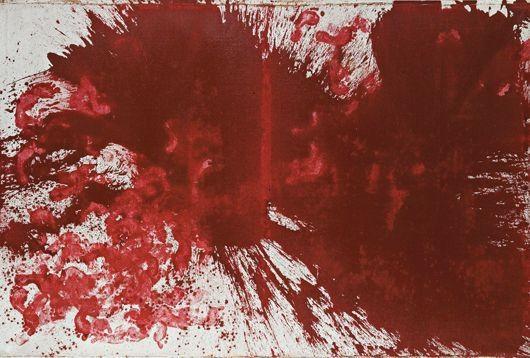
(Hermann Nitsch, "Schuttbild",1983)
(image from Gunter Brus's film "Self-Mutilation",1965)
Then, the same year, Rudolf Schwarzkogler created his “3rd Action”, where we can see a person wrapped in bandages, being injected in the head, which can be regarded as a symbol of the corrupted human mind. As part of the same movement, Hermann Nitsch created what he called “The Theatre of Orgies and Mysteries”, where he illustrated the concept of sacrifice through his performance acts, in which the public could recognise the influence of catholic rituals. Therefore, the crucifixion, the sacrifice of animals and many other religious practices were reinscribed into the world of contemporary art. Blood was a central element in most of the “actions”, and it was even used as paint in many of Nitsch’s artworks (for example, “Schuttbild”). It represented a turning point in the art world, a moment when violence and art started to fuse. When asked about his art, Nitsch claimed to have been inspired by Freudian theories and Christian symbols and the result is described as “aesthetic psychoanalysis”. He wanted to illustrate Freud’s idea that violence lies in the human unconscious and, therefore, we can find aesthetic pleasure within it.
(Hermann Nitsch, "Schuttbild",1983)
The responses to these performances were quite negative at first, as people have always been reluctant to explore the dark side of art. In fact, many of the “actionists” were arrested because of their shocking performances. Nowadays, despite this controversy, people are beginning to feel curiosity and fascination towards them, as they’ve discovered that this type of art awakens deep emotions. Consequently, performances involving painting with the artist's own blood as a symbol of a necessary sacrifice have started to grow on the public, and self-flagellation has become a well-known motif, a subject discussed even in art-oriented schools.
As far as I’m concerned, on one hand, I understand people’s reluctance regarding the influence that the combination of violence and art might have on the public. But on the other hand, I am fully aware of the fact that the animal-like aggression, the attraction to tanatos and the dark desires are all part of human nature. However, how we approach these inner features is of uttermost importance. Artists’ idea to make use of them and to consider their artistic potential may seem ugly and cruel at first, but I believe experiencing this form of art has the power of changing perspectives and broadening horizons, offering people a lot of food for thought.


Comments
Post a Comment